


La clemenza di Tito - Keynotes & More
Mozart
“This production will welcome some major Canadian artists to the Pacific Opera Victoria stage, including Andrew Haji, and Jennifer Tarver. La Clemenza di Tito brings together extraordinary vocal prowess and musical drama to illuminate a human story on both the micro and macro level. On one side, it is a tale of political intrigue, plots, and manipulation (a bit like the popular TV show “Succession”) and on the other side, it challenges us to think about forgiveness, and the cost of clemency on a human level.”
Brenna Corner, Artistic Director
Articles and Reviews
- Pacific Opera’s La Clemenza di Tito has an enduring quality – Monday Magazine
- Pacific Opera opens season with Mozart’s La clemenza di Tito – Victoria Times Colonist
- Pacific Opera presents Mozart’s ‘La clemenza di Tito’ – Mornings with Al Ferraby – Sound Bites | iHeart
- Theatre review: La clemenza di Tito at Royal Theatre
- Artist of the Week 22 Qs for Stephen Hegedus
- Pacific Opera Victoria – La clemenza di Tito – “The musicians in this production did it proud” – Opera Canada
- LA CLEMENZA DI TITO – REVIEW OF 2024 PACIFIC OPERA PRODUCTION
La clemenza di Tito Keynotes
Check out the digital version of La clemenza di Tito‘s Keynotes!
Featuring insightful articles by Alex Chen and Robert Holliston, these deep dives into the history and background of La clemenza di Tito are the perfect prelude to this extraordinary opera. Physical copies can be picked up at The Baumann Centre.
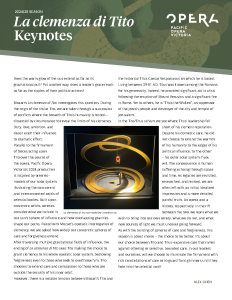
La clemenza di Tito House Programme
Read the digital version of La clemenza di Tito‘s House Program!
See in-depth notes from Artistic Director, Brenna Corner, as well as artist profiles, artistic and administrative staff.
Inside Opera | La clemenza di Tito
Robert Holliston hosts Maestro Giuseppe Pietraroia in a conversation about Pacific Opera Victoria’s upcoming production of Mozart’s LA CLEMENZA DI TITO.
La clemenza di Tito Synopsis
Act One
Vitellia, daughter of the late Roman emperor Vitellius (who was deposed by the present Emperor Tito’s father), wishes to regain the throne as the consort of Tito, whom she fancies. When she learns that Tito plans to marry the princess Berenice, Vitellia persuades Tito’s friend Sesto, who is in love with her, to assassinate the Emperor. But the Roman public’s demand that Tito choose a Roman empress causes him to renounce Berenice and send her away; thus Vitellia’s hopes that Tito will choose her as his Empress are revived, and she calls off the hit.
Tito now chooses Sesto’s sister Servilia as his bride, and sends Sesto’s friend Annio to inform Servilia. Annio and Servilia, unbeknownst to Tito, are in love, so they are saddened by this news. Servilia, sworn to obey her Emperor, nevertheless decides to be truthful about her real feelings; moved by Servilia’s honesty, Tito relinquishes her and blesses her betrothal to Annio. Simultaneously, Vitellia learns of Tito’s plan to marry Servilia, and she once again urges Sesto to assassinate him. Just after Sesto leaves to do the deed, Annio arrives with a guard to escort Vitellia to Tito, who has now chosen her as his empress. Wracked with guilt, Vitellia regrets sending Sesto on his murderous mission, but it is too late. Sesto is himself conscience-stricken, but the Capitol is set on fire. It is the accepted signal to overthrow the emperor. While the flames and mayhem spread, the Roman people express their terror. When Sesto tells Vitellia that Tito is slain, she begs him not to incriminate himself (and exposing her own part in the murder). All of Rome lament the death of Tito.
Act Two
In the imperial palace, Annio informs Sesto that Tito is still alive: amid the smoke and flames, Sesto had mistook another man for the Emperor. Sesto confesses his crime, but won’t divulge any reason for his actions. Vitellia begs Sesto to flee, but a fellow conspirator has already betrayed him, and he is summarily arrested. The Roman citizens rejoice that their Emperor has been spared. Tito cannot believe that Sesto would ever betray him, but is informed that Sesto has admitted his guilt before the Senate. Tito, having been urged to show compassion, refuses to sign the death decree until he has given Sesto a chance to explain himself. Sesto admits his crimes to Tito but declines to implicate Vitellia. Tito reluctantly condemns Sesto to death. Left alone, he is torn between his duty and his feelings, concluding that he can reign only if his power is rooted in love. Annio and Servilia beg Vitellia to use her influence to save Sesto; this means that she must admit her own guilt. At the arena where the conspirators await execution, Tito is about to show mercy to Sesto when Vitellia arrives and confesses her guilt. Again choosing clemency against all odds, Tito pardons Vitellia, Sesto, and all of the co-conspirators. As Tito’s subjects sing his praise, he declares that the gods may take his life on the day when clemency and the good of his country ceases to become his greatest concern.
Life of Emperor Titus #10 – The Good Emperor, Roman History Documentary Series
Who was the real Emperor Titus?
Emperor Titus was the first emperor to succeed his biological father on the imperial throne. He is considered to be one of the few good emperors. His short reign is best remembered for the opening of the Flavian Amphitheater(Colosseum) in Rome and the eruption on Mount. Vesuvius which lead the devastation of the bay of Naples.