Land, Language & Songs
Songs at the Spindle Whorls
Saturday
Sep 12, 2026
12:30pm
Venue Various
Cost Free


Land, Language & Songs invites audiences on a unique afternoon of music, storytelling, and discovery as downtown Victoria becomes a living performance space.
Part of Pacific Opera Victoria’s Found in Translation initiative, which celebrates Indigenous languages alongside those brought to Canada by newcomers, this free walking event explores how language, music, and place connect us to one another and to the land we share.
Beginning at Songhees Point, audiences are invited to follow a guided walking route linking four Spindle Whorl public art installations. With Opening and Closing gatherings by Songhees Knowledge Keeper Yuxwelupton Qwal’ qaxala (Bradley Dick), the journey features Pacific Opera Victoria artists performing works in Cree, Anishinaabe, Nuu-chah-nulth, Dakota, Toisan, Hindi, Japanese, and more, alongside stories and songs that celebrate the rich linguistic and cultural diversity of our community.
The afternoon concludes at Beacon Hill Park, where artists and audiences gather for a shared musical finale.
Participation is free, and guests are welcome to experience the full walking route or join at any of the scheduled stops.
This leisurely walking route includes approximately 15–20 minutes between each performance location.
12:30-1:00 p.m. – Opening Gathering
Songhees Point
Welcome with Yuxwelupton Qwal’ qaxala (Bradley Dick) and performances by Pacific Opera Victoria artists. We recommend bringing chairs or blankets as the Opening Gathering will at least be 30 minutes long.
1:30 p.m.
Victoria City Hall
Short musical performance.
2:05 p.m.
Inner Harbour
Short musical performance.
2:30 p.m.
Royal BC Museum
Short musical performance.
3:30 p.m. – Closing Gathering
Beacon Hill Park Lookout
Closing songs with Yuxwelupton Qwal’ qaxala (Bradley Dick) and Pacific Opera Victoria artists. We recommend bringing chairs or blankets as the Closing Gathering will at least be 30 minutes long.
About The Signs of lək̓ʷəŋən
(Photo and information courtesy of the Songhees Nation official webpage – please click here to read the page in its entirety, including information about each marker.)
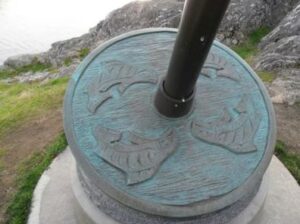
Created in 2008, The Signs of lək̓ʷəŋən consist of seven unique site markers that designate culturally significant sites to the Songhees and Esquimalt Nations along the Inner Harbour and surrounding areas. The markers are bronze castings of original cedar carvings that were conceptualized and carved by Coast Salish artist and master carver, Butch Dick with his son Clarence Dick Jr.
At 2.5 meters high and weighing close to 1000 pounds, the markers depict spindle whorls that were traditionally used by Coast Salish women to spin wool and were considered to be the foundation of a Coast Salish family.
The lək̓ʷəŋən People have hunted and gathered here for thousands of years. This area, with its temperate climate, natural harbours, and rich resources, was a trading centre for a diversity of First Peoples. When Captain James Douglas anchored off of Clover Point in 1842, he saw the result of the lək̓ʷəŋən People’s careful land management, such as controlled burning and food cultivation. These practices were part of the land and part of Lək̓ʷəŋən culture.
The development of a modern city makes it more difficult to experience the landscape that is home to the lək̓ʷəŋən. However, footprints of traditional land use are all around us, and this land is inseparable from the lives, customs, art, and culture of those who have lived here since the beginning.
The hills, creeks, and marshlands shaped the growth of the city of Victoria. There are messages in the landscape here; oral histories, surviving traditional place names, and the soil itself are all ancient stories waiting to be told. To follow the markers and visit these traditional places is to learn about the land, its original culture, and the spirit of its people. The traditions that were born here carry on today.
See all events- Found in Translation
- The Signs of Lək̓ʷəŋən
Found in Translation: Bridging cultures and community through song received funding from a Civic Practice Grant from OPERA America's Opera Fund.
Supported by Creative BC and the Province of British Columbia.
Elders & Translators
Singers
We want to acknowledge the fluent speakers of diverse Indigenous languages for their commitment to language presentation through their support of this program.